For many pharmacists, AI feels like the biggest unknown facing the profession
today.
That's why I keep hearing the same question: "Jana, should
I be worried about AI?"
It s a fair question. It s a smart question.
When Amazon expanded Health AI earlier this year, that
question went from occasional to almost constant. The concern is
understandable. After all, pharmacy has already experienced automation,
robotics, and digital transformation. But AI feels different because it's
beginning to sit closer to the patient experience itself.
The good news? The future of pharmacy isn't about competing
with AI. It's about understanding where pharmacists create value that
technology simply cannot.
And that's where the real opportunity begins.
My advice: don t panic prepare for the coming change.
Pharmacy has adapted to major technological shifts before. Automated dispensing
systems, electronic prescribing, robotic workflows, and electronic prior
authorizations all changed how work gets done. This moment feels different
because AI is beginning to handle tasks that once required direct pharmacist
involvement.
That deserves an honest conversation.
The good news is that the most valuable parts of pharmacy are still deeply
human. As routine tasks become more automated, clinical judgment, patient
relationships, leadership, and problem-solving become even more important.
The goal isn t to compete with AI. The goal is to focus on the work only
pharmacists can do.
What's Actually Being Automated
The tasks most vulnerable to automation tend to be high-volume, repetitive, and
rules-based. If a process follows a predictable path, technology will likely
perform it faster and more consistently over time.
The areas shifting most quickly include:
Routine prescription verification and dose checking
Refill requests and renewal routing
Drug interaction screening at scale
Prior authorization processing
Inventory management and dispensing workflows
None of this is meant to be alarming. In fact, the pharmacists navigating these
changes most successfully are the ones who understand what s evolving and adapt
accordingly.
What
AI Is Unlikely to Replace
One of the biggest misconceptions I hear is that task automation automatically
means job elimination. It doesn t.
Many of the most important responsibilities in pharmacy require trust, context,
judgment, accountability, and human connection. Those aren t things algorithms
do well.
Complex Clinical Judgment
A pharmacist reviewing a patient s complete picture medical history, adherence
concerns, provider habits, and real-world circumstances is doing far more than
processing data. That s clinical expertise.
Patient Counseling
Some conversations simply require another person.
Whether it s helping a newly diagnosed patient understand treatment, supporting
a family through a medication change, or reassuring someone who is anxious
about starting therapy, pharmacists provide guidance that technology cannot
replicate.
Medication Therapy Management
As patients live longer and medication regimens become more complex, the need
for MTM, chronic disease management, deprescribing support, and collaboration
with providers continues to grow.
Leadership and Team Development
Strong pharmacy teams are built by people who create trust, mentor colleagues,
improve communication, and foster accountability. Those skills are becoming
more valuable, not less.
Ethical Decision-Making
Healthcare rarely fits neatly into a flowchart. Pharmacists routinely navigate
situations where policy, patient needs, and clinical judgment intersect. Those
decisions require experience and responsibility that technology cannot assume.
The pharmacists who thrive over the next decade won t necessarily be the ones
processing the highest volume. They ll be the ones creating value where human
expertise matters most.
Five
Career Moves That Make Sense Right Now
1. Invest in clinical development.
The strongest hiring trends I m seeing involve pharmacists with deeper clinical
experience. Specialty pharmacy, MTM, collaborative practice, ambulatory care,
and advanced patient management skills continue to be highly sought after.
2. Learn to work with AI.
Organizations aren t looking for pharmacists who resist technology. They re
looking for professionals who can use it wisely, interpret its recommendations,
identify its limitations, and advocate for patients when judgment is required.
3. Strengthen counseling and communication skills.
The ability to educate, motivate, and connect with patients will continue to
differentiate great pharmacists. Communication is no longer a soft skill it s a
career skill.
4. Consider your practice setting.
Automation is affecting some environments faster than others. Clinical roles in
health systems, specialty pharmacy, ambulatory care, and collaborative care
models continue to expand and create new opportunities.
5. Be proactive. Embrace the Change.
If there s one piece of advice I d offer, it s this: don t wait for the
industry to tell you what your next move should be. The pharmacists thriving
today are staying curious, investing in themselves, and exploring opportunities
before they feel forced to.
A Note
for Pharmacy Leaders
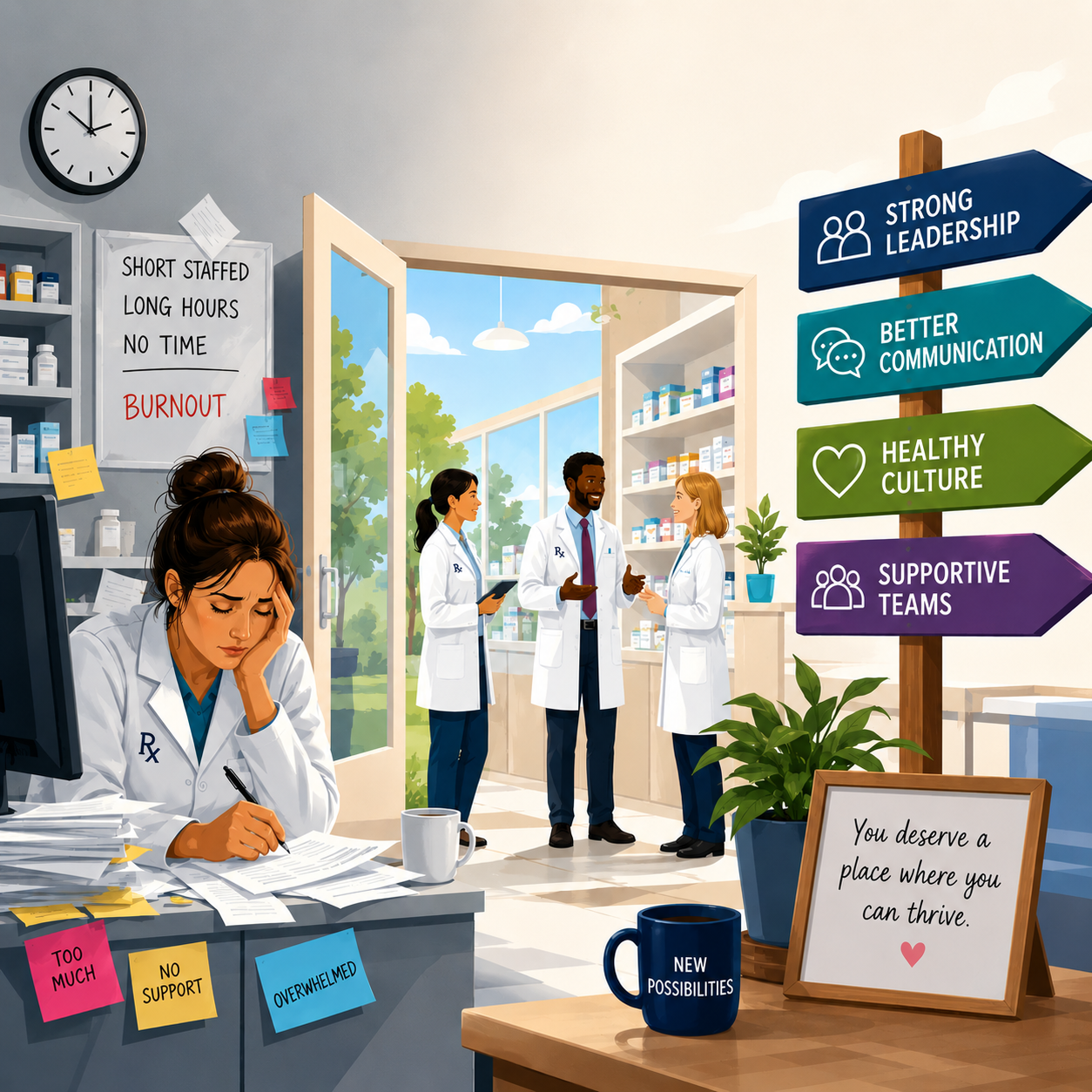
If you re hiring or building a pharmacy team, these same trends should
influence how you evaluate talent.
The professionals creating the most value today combine clinical depth,
adaptability, communication skills, emotional intelligence, and a willingness
to embrace new technology. Those qualities do not always jump off a resume,
which is why thoughtful recruiting matters more than ever.
Final
Thoughts
One thing I ve learned after decades of recruiting pharmacists is that this
profession is remarkably resilient.
The tools change.
The workflows change.
The technology changes.
What doesn t change is the need for knowledgeable, compassionate professionals
who can guide patients, support providers, and make sound clinical decisions
when it matters most.
AI will absolutely change parts of pharmacy.
But I don t believe it replaces pharmacists who continue learning, growing, and
leaning into the human side of healthcare.
If you re thinking about what comes next for your career or you re a pharmacy
leader building a future-ready team I d be happy to have that conversation.